I don't think I wrote an entry on what this trip is about. So I will rectify the situation. I am in St-John's more or less set to depart for Halifax via the Argentia ferry and the Cabot Trail. In Halifax, I will meet up with Philip, Dominique and Désirée from where we will travel by train back to Montréal.
This is an indulgence on my part as I have paid for our tickets back and my Via Rail points have paid for their tickets to Halifax. The latter bit was caused by three trips on the Canadian * and several trips to Toronto and back. It is about me wanting to give Désirée (and to lesser extent Dominique and Philip) a really memorable experience. I was her age when Grandpa took us to Scotland.
Also in the plan was taking the time to enjoy St-John's. I have been blessed with good weather for Newfoundland. It has been gorgeous so far except for rain yesterday which was an opportunity to do indoor activities without feeling I was wasting good weather.
I started with the Catholic cathedral of St-John the Baptist (having done the Anglican one the day before). It struck me as over-large but the tour guide said she'd seen it jammed with 4000 people or so. Interestingly, it features an icon or set of icons featuring Our Lady of Fatima and her now-canonised witnesses. It was given by Portugal or at least her fishermen who frequented the Grand Banks and St-John's back in 1955 when the gift was made as a centenary present for Cathedral. The guide betrayed her biases by saying the Portuguese fishers identified with the "oppressed" Irish Catholic Newfoundlanders. I couldn't help but point out that Portugal is (and was) a very Catholic country. She said the fishermen were being exploited by the Portuguese upper classes. They probably were, but I had to refrain from pointing out that one of the tools the Portuguese dictator of the time (Salazar I believe) were the three "F"s which were allowed to dominate the media as they were safe: Football, Fado and...Fatima. She said the shrine was a favourite with her kids and that was easy to understand as the figures were toy sized and shaped. Pretty much the rest of the Cathedral was built large. Unlike its Anglican counterpart, the Cathedral was set in a large complex of buildings supporting Catholicism in Newfoundland including a college or high school.
Also nearby was the Rooms. This is in essence the Provincial Museum of Newfoundland and Labrador. Designed to evoke the simple fishing shacks in outports known as "rooms", the building has two main parts whose red-roofs dominate the skyline. One half is an art gallery, the other a museum.
I started with the museum which gave prominence to an exhibit about the tragic story of the Newfoundland Regiment in WWI where in about one hour on July 1, 1916, it suffered 90% casualties, which may have resulted in a genetic bottleneck in Newfoundland.
There were other good exhibits, though the label of a whale skull should have had more than the Latin name for the minke whale! Also, I found that labelling a skidoo as belonging to the Inuit culture as a bit much.
Maybe it was the proximity to the Catholic Cathedral, but I found there was an Irish Catholic bias to the presentation. I also felt the need to bone up on my pre-Confederation Newfoundland history.
I went into a nearby Sobey's in search of milk and ziplock baggies. While I was there, I overheard a mainlander couple talking about whether their lodgings had a microwave. This would have not been significant except it turned out they were sharing accommodations with me, something we only found out when we got home. They were a couple of school teachers from Winnipeg. We had a good chat over some Quiddy Viddy beers.
Later that evening and against my better judgement, I got screeched-in at Trapper John's on George Street. This involved consuming a small amount of actual baloney ("Newfoundland steak") and a lot of verbal baloney which perpetuated the myth that the green-white-pink tricolour was actually the official flag of the Rock prior to 1949. It also avoided the origins of "true Sreech" (barrel dregs and I can testify that the process results in something harsh). The blarney also romanticised the Newfoundland-Jamaica connection, leaving out the fact that salt fish was food for slaves. Good fun.
Today, I took a trial run out to Pouch Cove. When I got there, I was contemplating the steep boat ramp down to a very narrow inlet, when an older local asked what the gulls were up to? I replied that they were just squabbling. This led to a long conversation about Pouch Cove and its history.
I somehow missed the museums in Torbay and Logy's Bay and made Quidi Vidi in time for the two o'clock brewery tour with tasting. Both the tasting and the tour were underwhelming.
I wanted to get to the gun battery that had protected the 20 foot entry into Quidi Vidi. This involved a circuitous route via the Cuckhold Cove Road. I got as far the Cove when a vista including Cape Spear distracted me. During the photo op, I noticed people gazing out sea, looking at whales. There was a fair number of minke whales in sight. Some of them were so close and so shallow that I could track them underwater with my binoculars from their white underbellies. That pretty much ended my afternoon.
I never did find the battery.
Ferryland tomorrow.
*My talking about the Canadian at work has resulted in a co-worker going a vacation with her family which will include taking the Canadian from Edmonton to Vancouver. I have given a lot of advice.
Thursday, 27 July 2017

Monday, 24 July 2017
On my first 24 hours in St-John's
Getting to my plane for this jaunt took a lot out of me. I think it was depression talking or maybe just a relative lack of prep. The flight itself was great with clear weather and a left hand seat on the plane that allowed me to see North Hatley and St-Pierre et Miquelon.
Getting from St-John's Airport was so quick and smooth that within an hour of getting my luggage, I was hoisting a pint of Quidi Vidi IPA in the Duke of Duckworth, as made even more famous in "The Republic of Doyle" TV show. I had made the "mistake" of binge watching the last two seasons in the last two months, so I keep on expecting an old Pontiac GTO to surge over the crest of a hill. ;-) This is a reference to the private eye show set in St-Johns'. Actually, I am beginning to think someone could make money with a "Republic of Doyle" tour of St-John's.
That was yesterday.
Today was also full of sunshine. I assembled Leonardo, gathered information and moseyed around the town in an aimless fashion. My path took me along the harbour. I chanced upon HMCS Glace Bay tied up to a wharf. Glace Bay is a Kingston-class coastal defence vessel that can be configured for a variety of missions such as mine hunting and the like. They are small vessels, not intended for serious conflict. However, there was something about her that made me ask one of officers an important question: "Where was her main gun?" In theory, she was supposed to be armed with a 40 mm Bofors gun in what is termed a "Boffin" mount. Her answer was typical of today's RCN. The Bofors were now too old, having references to King George on their inspection plates. So the Navy is in the process of replacing the guns, but for the time being HMCS Glace Bay is conducting fisheries patrols with out her main gun, hoping that a pair of fifty caliber machine guns (which might be just as old) will suffice to overawe fishing boats.
As I was reassembling Leonardo this morning, a pickup truck parked outside my lodgings and a man in uniform got out. He was wearing a knife and/or bullet resistant vest marked "Sheriff" in large white letters. He walked off. From "the Republic of Doyle", I had learnt of the existence of sheriffs in Newfoundland but knew squat about how they fitted into the Newfoundland and Labrador justice system. I filed this thought away until the afternoon when as I was coming out of my lodgings and the same sherif was going out to his truck. I took the direct approach and asked him. It seems sheriffs are agents of the provincial courts and do things like prisoner transports and serving warrants or writs to appear in court.
Items forgotten so far are a T-shirt for sleeping in and a universal plug. Both omissions have been rectified, the former by a 2XL "Bat-moose" logo T-shirt and the latter by a test-run trip on Leonardo to Canadian Tire. I came back via Quidi Vidi.
Getting from St-John's Airport was so quick and smooth that within an hour of getting my luggage, I was hoisting a pint of Quidi Vidi IPA in the Duke of Duckworth, as made even more famous in "The Republic of Doyle" TV show. I had made the "mistake" of binge watching the last two seasons in the last two months, so I keep on expecting an old Pontiac GTO to surge over the crest of a hill. ;-) This is a reference to the private eye show set in St-Johns'. Actually, I am beginning to think someone could make money with a "Republic of Doyle" tour of St-John's.
That was yesterday.
Today was also full of sunshine. I assembled Leonardo, gathered information and moseyed around the town in an aimless fashion. My path took me along the harbour. I chanced upon HMCS Glace Bay tied up to a wharf. Glace Bay is a Kingston-class coastal defence vessel that can be configured for a variety of missions such as mine hunting and the like. They are small vessels, not intended for serious conflict. However, there was something about her that made me ask one of officers an important question: "Where was her main gun?" In theory, she was supposed to be armed with a 40 mm Bofors gun in what is termed a "Boffin" mount. Her answer was typical of today's RCN. The Bofors were now too old, having references to King George on their inspection plates. So the Navy is in the process of replacing the guns, but for the time being HMCS Glace Bay is conducting fisheries patrols with out her main gun, hoping that a pair of fifty caliber machine guns (which might be just as old) will suffice to overawe fishing boats.
As I was reassembling Leonardo this morning, a pickup truck parked outside my lodgings and a man in uniform got out. He was wearing a knife and/or bullet resistant vest marked "Sheriff" in large white letters. He walked off. From "the Republic of Doyle", I had learnt of the existence of sheriffs in Newfoundland but knew squat about how they fitted into the Newfoundland and Labrador justice system. I filed this thought away until the afternoon when as I was coming out of my lodgings and the same sherif was going out to his truck. I took the direct approach and asked him. It seems sheriffs are agents of the provincial courts and do things like prisoner transports and serving warrants or writs to appear in court.
Items forgotten so far are a T-shirt for sleeping in and a universal plug. Both omissions have been rectified, the former by a 2XL "Bat-moose" logo T-shirt and the latter by a test-run trip on Leonardo to Canadian Tire. I came back via Quidi Vidi.
On Canada Day in Whitehorse and tangential references to Newfoundland and a niece
My tendency to procrastinate has meant that I am going to write this entry on my trip to the Yukon while in St-Johns'.
Plan A for Canada Day had been to drive to Kluane National Park and back. However, the forecast was for low cloud and rain. Furthermore, I was getting tired of driving so I decided to give it a miss and take in the Canada celebrations in and out of Whitehorse.
Whitehorse, being territorial capital, put on a pretty good shindig. The RCMP and the military were out, the former in red serge and the latter in red sweatshirts. By this I refer to a party of Canadian Rangers whose uniform consists of red sweatshirts and camouflage pants. The RCMP was showing off their "latest" squad car, namely a classic VW Beetle. I got to sit inside and got someone to take a shot of me. I don't remember being in a Beetle though I am reliably informed by my parents that my first trip in a car was in one as that was what they owned when I was born. Family lore says I was at times transported in a cot that was placed in the storage area behind the back seats. I had never really given this much thought aside from thinking "how times have changed with regards to child safety." However, I used the opportunity to check out this area. There was indeed a space that "just begged" for baby storage. ;-) (This is not meant as a criticism of my parents.)
I also rode in Whitehorse's trolley which offers limited service.
Other highlights included a salmon on bannock sandwich from the Kwalin Dun Cultural Centre and a performance by the Inuvik Drummers and Dancers dressed in their show anoraks. This performance of traditional Inuit dances made me think just what a harsh environment they live in. How many other cultures have special mittens for dancing? ;-) Actually, the mitts were meant to evoke claws or feathers.
In the evening, I went to the Mount Lorne community party with Karen. It was free burgers and potluck salads. The local firefighters showed off their truck. I had to what the two soccer balls were for. As I expected, they were intended for the celebrations. I participated in a tug-of-war and listened to live music. I bought a bottle of beer with supper which I followed later with some Growers Cider. As I returned the cider bottle to the bar, I was asked if I wanted another. I replied, with a certain humour: "No, thank you, I am driving. In fact, I forbid you sell me any more alcohol." The man was slightly taken aback, but the woman assisting him was faster on the uptake and said: "I'm a witness to what he said."
The only thing of note was that on the trip back to Montreal, I watched a documentary about Gordon Pinsent that I heard about on Karen's radio in an interview with the noted actor and the second most important person born in Grand Falls-Windsor. Alice's Anna being the most important one. I have been accused of being biased on this point. I take the view that certain biases are acceptable provided you are open about it. ;-) Actually, I think that Gordon would accept the reason behind my bias.
Plan A for Canada Day had been to drive to Kluane National Park and back. However, the forecast was for low cloud and rain. Furthermore, I was getting tired of driving so I decided to give it a miss and take in the Canada celebrations in and out of Whitehorse.
Whitehorse, being territorial capital, put on a pretty good shindig. The RCMP and the military were out, the former in red serge and the latter in red sweatshirts. By this I refer to a party of Canadian Rangers whose uniform consists of red sweatshirts and camouflage pants. The RCMP was showing off their "latest" squad car, namely a classic VW Beetle. I got to sit inside and got someone to take a shot of me. I don't remember being in a Beetle though I am reliably informed by my parents that my first trip in a car was in one as that was what they owned when I was born. Family lore says I was at times transported in a cot that was placed in the storage area behind the back seats. I had never really given this much thought aside from thinking "how times have changed with regards to child safety." However, I used the opportunity to check out this area. There was indeed a space that "just begged" for baby storage. ;-) (This is not meant as a criticism of my parents.)
I also rode in Whitehorse's trolley which offers limited service.
Other highlights included a salmon on bannock sandwich from the Kwalin Dun Cultural Centre and a performance by the Inuvik Drummers and Dancers dressed in their show anoraks. This performance of traditional Inuit dances made me think just what a harsh environment they live in. How many other cultures have special mittens for dancing? ;-) Actually, the mitts were meant to evoke claws or feathers.
In the evening, I went to the Mount Lorne community party with Karen. It was free burgers and potluck salads. The local firefighters showed off their truck. I had to what the two soccer balls were for. As I expected, they were intended for the celebrations. I participated in a tug-of-war and listened to live music. I bought a bottle of beer with supper which I followed later with some Growers Cider. As I returned the cider bottle to the bar, I was asked if I wanted another. I replied, with a certain humour: "No, thank you, I am driving. In fact, I forbid you sell me any more alcohol." The man was slightly taken aback, but the woman assisting him was faster on the uptake and said: "I'm a witness to what he said."
The only thing of note was that on the trip back to Montreal, I watched a documentary about Gordon Pinsent that I heard about on Karen's radio in an interview with the noted actor and the second most important person born in Grand Falls-Windsor. Alice's Anna being the most important one. I have been accused of being biased on this point. I take the view that certain biases are acceptable provided you are open about it. ;-) Actually, I think that Gordon would accept the reason behind my bias.
Saturday, 22 July 2017
On getting back to Whitehorse
I had missed the startof the Dempster Highway on my way to Dawson City, so I stopped to look at the information displays about it on my way South. I was amused to see a printout thumbtacked to the woodwork warning cyclists about an agressive grizzly that had been spotted along the Highway. It seems that biking the Dempster is not that rare a trek!
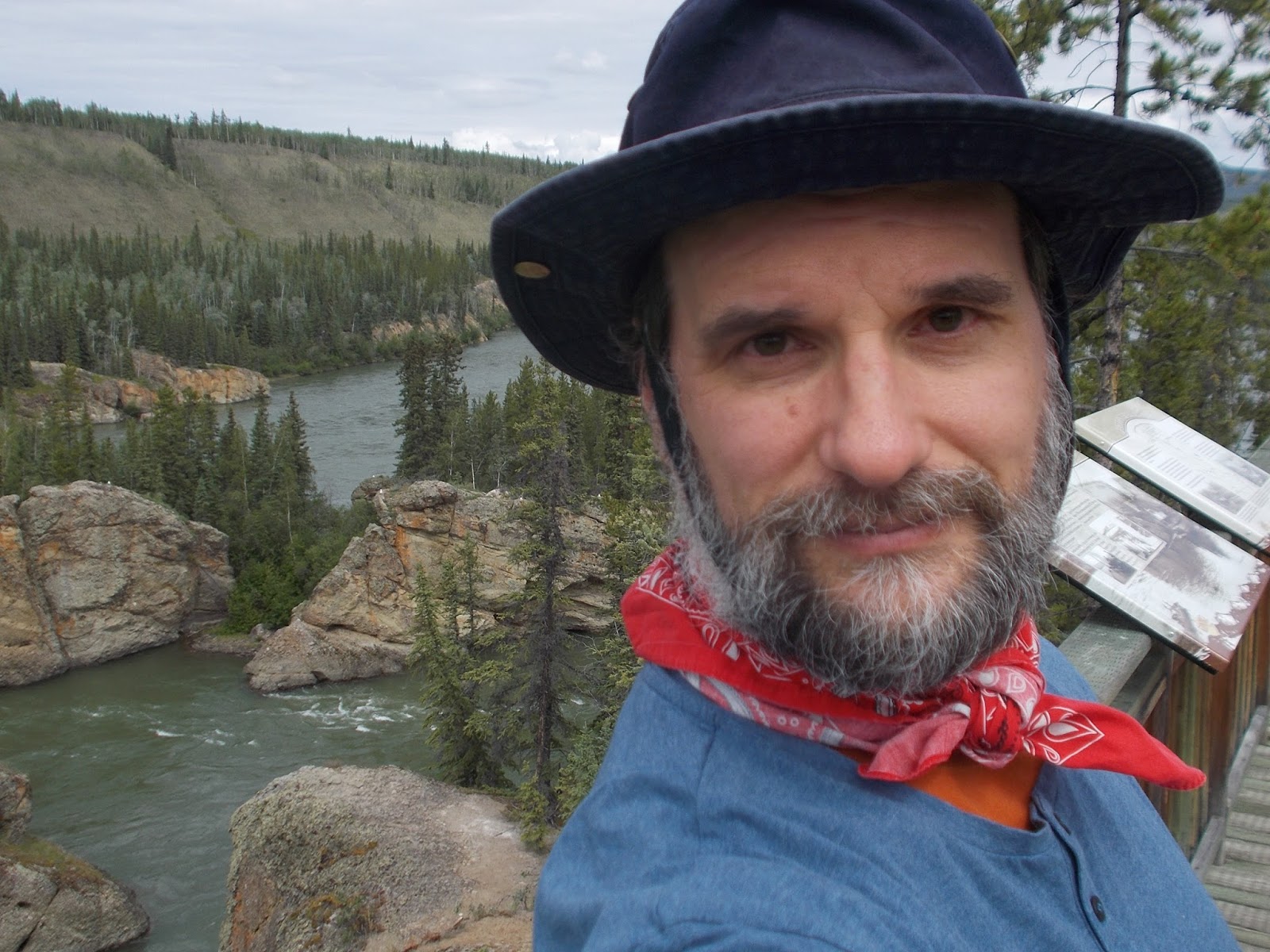
 I stopped to gaze at the Five Fingers Rapids. After several false starts in order to return to the car for such things as bear spray, water, rain jacket, bug dope, camera, I hiked down to a view point. The trees were mostly quite close to the path and lacking a bear bell, I whistled and sang my way along to avoid surprising a bear. The path led to a vantage point just beside the river. I looked out at the massive rocks and marvelled at how people had steered riverboats through the one navigable gap between them.
 I did the obligatory selfie and returned to the car.
 Just as I was pulling out the parking lot, I caught sight of some boats coming around a bend in the river. These, I guessed were participants in the Yukon River Quest, a race for canoes and kayaks from Whitehorse to Dawson City. I returned to the parking lot, informed the other tourists and stood on the view platform with binoculars and camera at the ready. You can see them above the spit of land near the far bank as some blobs. As I left, I photobombed a group of Holland-American cruise liner passengers who had alighted from their bus for a photo op.
 I pulled into the Coalmine Campground for lunch only to find the parking lot full of RVs. I parked near the canteen. An older woman in a high-viz vest challenged me with the question: "Are you here for the River Quest or the canteen?" I said the canteen and was allowed to leave my car where I had parked it. It seems that the Campground was a checkpoint and mandatory rest stop for the Yukon River Quest. While the management enjoyed the River Quest business, they wanted to make it easy for canteen customers to park. I did allow as how I intended to take a gander at the proceedings as well as eat, but she didn't mind.
 The River Quest was quite the affair and I looked around and spent a few minutes looking at a board with names of the teams and which category they belonged to. The categories were described by letters and number such as C2 and K1. I deduced quite quickly that "C2" meant "2 person Canoe", but was take aback by "VC8". After scratching my head a bit, I came up with "8 person Voyageur Canoe". I asked a member of the staff if I was correct. She said I was, and ask if had I figured out "SUP"? I sheepishly said I hadn't tried. She said it was for "Stand-Up Paddleboard"! The idea of stand-up paddleboarding for 700 kms struck me as masochistic, but that wasn't my problem!
 I got to Whitehorse in time to visit the Yukon Transportation Museum. The museum suffered from having too many "don't touch the artifacts" signs and not enough signs saying what the artifacts were. It did have a nice panel about a proposed bike route from Skagway to Whitehorse circa 1900.

 The idea was risible in the extreme and consequently, it didn't happen. Afterwards, I had supper at the Kopper King (immortalised in Stan Rogers' Canol Road) then a soak at the Takahni Hot Springs.
The next morning, I had the worst experience of my trip. I had gone into the Yukon Liquor store in search of some liquid souvenirs. I was in the process of purchasing a couple of bottles of what turned out to be disappointing booze, when a First Nations woman came in and was brusquely told by a staff member that no backpacks were allowed in the store. She promptly turned around showing she was wearing a tiny backpack and walked out the door. The thing was, I was just about to put my purchases into my quite large backpack that I had been openly and casually wearing as I wandered up and down the aisles looking for something interesting. I felt extremely uncomfortable at what seemed to be open racism. And being a weak-willed coward, I didn't say a damn thing on the off chance that it was a case of someone with whom the staff had frequently had trouble and who had been given many warnings in the past. But it sure didn't feel right.
In the afternoon, I drove out to see David, Karen's amicably divorced ex-husband. He is currently in a shack next to a house that he co-owns with Karen. The house is in the process of being moved to foundations on higher ground as the level of the lake it is next to is rising.
 I was impressed that the contractors were First Nations.
 David is a character. He was going to take me on a hike nearby, though owing to a bad ankle, we cut it down to a fairly sedate walk up a gravel road. He regaled me with the names of countless mountains, valleys and hikes they had been on, of which I made no attempt to remember but merely smiled politely. One place we might have hiked was on land controlled by a mining company which had a sign asking people to report in, just in case. David told me that one time he had checked in with a mining company in order to go on a hike, he had ended up getting a job there as he had a degree in mining engineering! A few hundred metres up the gravel road, I spotted an area with numerous signs of recent human occupation. We looked around and did some observational archeology trying to figure just what had been going on there. My guess that people used the spot for celebrations, and had been for some time as there was cut timber which had been exposed to the weather for varying lengths of time. There was also an iron bedstead wedged into several trees. I would have said that it had been used for barbecueing meat, but there wasn't any signs of a fire being lit under it. Whoever they were, they deserve credit for leaving very little garbage.
We walked up the road for a few kilometers then turned around. As we neared David and Karen's pickup, I noticed a bright orange piece of plastic on the road. "You know, that looks like the safety cap from a can of bear spray." David agreed and after I checked to see that his can still had it's cap, he inspected mine. (Our cans were on our backpacks, close to hand, but hard to see.) The cap was mine. (David commented that most people in the Yukon are glad that there are bears around but would rather not have to deal with them.)
 Back at David's cabin, we discussed a range of topics including geology, history, literature, TV. And dog-sledding as David has some 17 huskies.
As David is getting on in years, he is no longer adding new dogs and the average age of his pack is over 10. He introduced me to his pack and I managed to register only one of the names ("Katana"). I did manage to learn quite a lot about dog-sledding including a titbit he learnt from a professional racer when he was asked on TV about what qualities he looked for in a sled dog. He said he wanted a dog that could rest. David explained that almost all huskies can run well. However, huskies that can stop running and lie down and rest quickly are good as they recover their strength. He illustrated this by giving the example of one of his dogs who was always somewhat crazy and didn't settle down. (I met that particular dog and can testify that it was on the wild side.) He also had a very good eye for dog flesh and described Cirrus as having the makings of a good sled dog.
In dealing with the pack as well as several other huskies on this trip, I was struck by how much body language huskies have available. The mobility of their ears and the position of their tails make it relatively easy to figure out where they are emotionally.
 In our historical discussions, David put forward his opinion that the Umbrella Final Agreement (a comprehensive and progressive land claims settlement signed in 1992) was one of the two significant events in Yukon history, the other being the Klondike gold rush. I agreed that both of them must be considered significant but thought that he should add a third event, namely the construction of the Alaska Highway. Before then, travel to and in the Yukon had been either very difficult or reliant on transportation companies (i.e. riverboats, the White Pass and Yukon Railroad, or aircraft). Afterwards, individuals could easily drive in and out of the area. I reinforced my argument by pointing out that it was shortly after the opening of the Alaska Highway that the capital of the Yukon was moved from Dawson to Whitehorse which then stood at the juncture of three major transportation networks (the railroad, the Yukon River and the Highway). He conceded the point adding that he had arrived in Whitehorse on a motorcyle via the then unpaved Alaska Highway in about 1980.
(In the interest of full disclosure, earlier in this blog, I referred to the three important events in the history of the Yukon. I got the notion from this conversation with David and claim only the addition of the Alaska Highway as being even remotely original.)
 When I got back to Karen's, she and Kendra were setting off with Affry and Sirrus to go bike skijoring. This means the dogs were pulling the bikes that Karen and Kendra were riding. I must confess I felt nervous for them, but they seemed quite happy, especially the dogs!




The next morning, I had the worst experience of my trip. I had gone into the Yukon Liquor store in search of some liquid souvenirs. I was in the process of purchasing a couple of bottles of what turned out to be disappointing booze, when a First Nations woman came in and was brusquely told by a staff member that no backpacks were allowed in the store. She promptly turned around showing she was wearing a tiny backpack and walked out the door. The thing was, I was just about to put my purchases into my quite large backpack that I had been openly and casually wearing as I wandered up and down the aisles looking for something interesting. I felt extremely uncomfortable at what seemed to be open racism. And being a weak-willed coward, I didn't say a damn thing on the off chance that it was a case of someone with whom the staff had frequently had trouble and who had been given many warnings in the past. But it sure didn't feel right.
In the afternoon, I drove out to see David, Karen's amicably divorced ex-husband. He is currently in a shack next to a house that he co-owns with Karen. The house is in the process of being moved to foundations on higher ground as the level of the lake it is next to is rising.


We walked up the road for a few kilometers then turned around. As we neared David and Karen's pickup, I noticed a bright orange piece of plastic on the road. "You know, that looks like the safety cap from a can of bear spray." David agreed and after I checked to see that his can still had it's cap, he inspected mine. (Our cans were on our backpacks, close to hand, but hard to see.) The cap was mine. (David commented that most people in the Yukon are glad that there are bears around but would rather not have to deal with them.)
As David is getting on in years, he is no longer adding new dogs and the average age of his pack is over 10. He introduced me to his pack and I managed to register only one of the names ("Katana"). I did manage to learn quite a lot about dog-sledding including a titbit he learnt from a professional racer when he was asked on TV about what qualities he looked for in a sled dog. He said he wanted a dog that could rest. David explained that almost all huskies can run well. However, huskies that can stop running and lie down and rest quickly are good as they recover their strength. He illustrated this by giving the example of one of his dogs who was always somewhat crazy and didn't settle down. (I met that particular dog and can testify that it was on the wild side.) He also had a very good eye for dog flesh and described Cirrus as having the makings of a good sled dog.
In dealing with the pack as well as several other huskies on this trip, I was struck by how much body language huskies have available. The mobility of their ears and the position of their tails make it relatively easy to figure out where they are emotionally.

(In the interest of full disclosure, earlier in this blog, I referred to the three important events in the history of the Yukon. I got the notion from this conversation with David and claim only the addition of the Alaska Highway as being even remotely original.)

Friday, 21 July 2017
On getting my word in at work
I have been biking to work for eighteen years now. In that time, I have often thought that the bike parking at the building was sub-optimal. (The building and its surrounding roads and parking lots were designed in the mid-eighties and reflect the suburban thinking of the time.) For most of that time, there was only one bike rack and its design reflected a time when bikes weren't locked. I have quietly endeavoured to advocate better bike parking arrangements.
This summer, the back parking lots of the building are being remade. This afternoon, I was asked to consult with the project manager about where bike racks would be best located and oriented. I was more than happy to contribute!!!! The project manager got my perspective on the matter of bike parking, and accepted my advice within the constraints of the project.
I feel chuffed.
This summer, the back parking lots of the building are being remade. This afternoon, I was asked to consult with the project manager about where bike racks would be best located and oriented. I was more than happy to contribute!!!! The project manager got my perspective on the matter of bike parking, and accepted my advice within the constraints of the project.
I feel chuffed.
Sunday, 16 July 2017
On Dawson City
Dawson City is an odd place. It was a nothing place until the Goldrush which caused the population to reach 40,000 in 1898 (more than the current population of the whole Yukon). Yet within 5 five years, the population fell to less than 5,000. Moreover, within ten years or so, the nature of the place underwent a shift from a town of sourdough prospectors to a territorial capital with pretensions of grandeur, electricity and corporate bigwigs. Individual claims were replaced by large mining concessions using equipment on a massive scale. Yet the image of Dawson is that of the sourdough. However, precious little of that is actually around. The buildings, in various states of repair, are those of the Edwardian era Dawson which slowly faded as 20th century wore on. This process was hastened when Whitehorse became the capital in 1953. Pierre Berton made an NFB film in 1957 called City of Gold which describes the fading town. Berton and his works have contributed heavily to Dawson City now enjoying a new life of tourism playing on the past, but the past being promoted is very much a sepia-toned one. Not that it is the only past being shown as if I see other pasts, then so might others, even if they don't have my background in history. For one thing, there is now a very conscious effort to get the First Nations version of events put out.
One example of this confused spirit might be where I stayed, Bombay Peggy's Inn and Pub. It is named after a brothel owner who was active as late as the 1930s if my guess about her picture is anything to go by. The inside of the building is done up in pseudo-Victorian splendour. The Inn offers complimentary private label sherry or port to its guests. The pub offers a list of cocktails which bears scrutiny as the names are often the only inventive thing about them. I give you the example of the "Bloomer Dropper" which consists of gin, vermouth and olive. This cocktail is better known as the Martini. When I pointed this out to the bartender, he shrugged and brought my attention to the "Spank me I'm naughty" which he said was in fact a cosmopolitan. I will give them credit for their Dark and Stormy which featured spiced rum and Crabbie's (alcoholic) Ginger Beer.
 The down side of staying there was that bar patrons would exit the building for a smoke and have loudish conversations late at night. Or more accurately, very late in the evening as the Sun set at around a quarter to one in the morning. The above photograph was taken after I was woken up at half-past midnight.
 The only paved street in town was the Klondike Highway and I couldn't help wonder if this was because it gave the place a frontier atmosphere and created a rationale for the wooden sidewalks! I was also surprised by the presence of a pedicab!
 In the morning, I walked over to the ferry landing to bear witness to a line of some two dozen RVs waiting to cross so they could drive the Top of the World Highway to Alaska. My guess is that they were in for a long wait as the small ferry gave priority to other vehicles, such as those of the Transport Ministry. I got on the ferry just for fun and the only RV to get on was one that had been taken out of sequence as it was fairly small!
 I spent the day seeking out various historic sights, including a Parks Canada tour of downtown which went inside several old buildings and included "chance" encounters with Mme Tremblay, a reenactress of a past era.
 One of the things on my list for Dawson was Dredge Number 4. This is the largest wooden dredge in the world, which probably means less than it sounds. It was described as being 8 stories tall and the pins linking its buckets together in a chain were over a ton each. It was a floating factory with no means of propulsion (its position was controlled by cables attached to anchor points on land) or indeed power source (it was powered by electricity generated many miles away, supplied by wires). It was a study in contradictions. It only took 4 people to operate it, but required about a hundred to keep it going as in order to scoop up the ore-bearing gravel, there was a lot of prep work to be done. It was up Bonzana Creek (site of the initial discovery) and the stream I saw as I drove up was small. It seems that it sat in a pond of its own creation, one which it could bring with it by eating up the ground in front and spewing it out behind. Yet however massive it was, it worked on the same placer mine principle as the sourdough miners used. Gold bearing gravel was shifted, shaken and washed and the gold sank to the bottom. It operated until the winter layover of 1959-1960. In the spring of 1960, a dam broke upstream of the dredge and it was flooded with water, gravel and sand. The owners decided it wasn't worth salvaging and wrote it off. It is now property of Parks Canada.
 The shack housing the admissions booth for the Dredge featured a mining pan and a satellite dish on the wall! The tour showed us and let us handle a one-ounce nugget of gold.
There was a mining operation just up the creek that was re-shifting the gravel in the hopes of finding more gold, that which two previous efforts had missed. As I drove down past spoil heaps of gravel, I wondered if the gravel might be useful as "pre-mined" construction material. I then thought of the issue of the residual gold content which would have made it too valuable to use for road building! This prompted me to stop and gather up some sand for Dominique!
 Back in town, I went on a tour of the former Commissioner's Residence (the Commissioner being the territorial equivalent of a provincial lieutenant governour). More Edwardian splendour and more Parks Canada reenactors giving vignets of the past, particularly the 1900s when Dawson City was transitioning from sourdough to corporate mining.
 Like much of Dawson, it was a ghost of the past.
 Me being me, I went to the museum and found out more about the odd history of Dawson. I was also fascinated by the railway annex featuring several old narrow gauge locomotives that had been used for a few years then abandonned for the amusement of children such as Pierre Berton. I was fascinated by the inner wheels of one of the locomotives which lacked the normal flanges seen on train wheels to keep them on the rails. The locomotive in question featured four linked driving axles. As the railway was probably quite winding, the relatively long, rigid wheel base would not have been able to cope with the curves unless the middle axles were allowed to shift. I had read about such arrangements, but this was first time I saw it.
 All through the day, I kept on seeing and talking to cycle-tourists including a couple of young lads from Vancouver, a Japanese man about 7 years into his trip and an Italian.
 I felt a little sheepish for not having invented a way to make the trip into bike expedition. However, que sera, sera.
While having supper in the Drunken Goat Taverna, I found I was sitting next to a colourful local character called Larry. He claimed he lived by hunting, trapping and piloting barges on the Yukon River. There is still commercial traffic on the River which, as I expected, consists mostly of heavy equipment for mines and fuel. Larry seemed almost too colourful to be real. He claimed not to have much education with the exception of a fascination for Robert Service. He asked me with a straight face if I knew any of Service's work. I answered with "There are strange things done in the midnight sun, by the men who moil for gold."
 I ended the day by going to Diamond Tooth Gertie's Gambling Hall. This features gambling and can-can dancers. It was a surreal experience. The dancers were putting on a show that was obviously done for the tourists. Yet in this day and age, tourists know that such things are only done for their benefit. Compounding the mix is the fact that burlesque is now viewed as a feminist statement. So who was fooling who?
 The confusion didn't prevent me from posing with the dancers. However, as I was standing at the back, I didn't get asked to join them on stage like some other patrons.
 Later that evening, I stopped by the Downtown Hotel where the fabled Sourtoe Cocktail is served. I managed to avoid having one. In fact, I managed to avoid having anything there as the atmosphere was more akin to a themed bar on a cruise ship than anything else.
One example of this confused spirit might be where I stayed, Bombay Peggy's Inn and Pub. It is named after a brothel owner who was active as late as the 1930s if my guess about her picture is anything to go by. The inside of the building is done up in pseudo-Victorian splendour. The Inn offers complimentary private label sherry or port to its guests. The pub offers a list of cocktails which bears scrutiny as the names are often the only inventive thing about them. I give you the example of the "Bloomer Dropper" which consists of gin, vermouth and olive. This cocktail is better known as the Martini. When I pointed this out to the bartender, he shrugged and brought my attention to the "Spank me I'm naughty" which he said was in fact a cosmopolitan. I will give them credit for their Dark and Stormy which featured spiced rum and Crabbie's (alcoholic) Ginger Beer.


There was a mining operation just up the creek that was re-shifting the gravel in the hopes of finding more gold, that which two previous efforts had missed. As I drove down past spoil heaps of gravel, I wondered if the gravel might be useful as "pre-mined" construction material. I then thought of the issue of the residual gold content which would have made it too valuable to use for road building! This prompted me to stop and gather up some sand for Dominique!


While having supper in the Drunken Goat Taverna, I found I was sitting next to a colourful local character called Larry. He claimed he lived by hunting, trapping and piloting barges on the Yukon River. There is still commercial traffic on the River which, as I expected, consists mostly of heavy equipment for mines and fuel. Larry seemed almost too colourful to be real. He claimed not to have much education with the exception of a fascination for Robert Service. He asked me with a straight face if I knew any of Service's work. I answered with "There are strange things done in the midnight sun, by the men who moil for gold."


On getting to Dawson
I had decided that I couldn't go to the Yukon without going to Dawson City. In the planning stages back in Montreal, I had used Google Maps to work out that Dawson was some five hundred klicks from Whitehorse which seemed a reasonable distance to drive. Yet somehow, when I got to the Yukon, it became a greater distance in my mind. I think this was partly because I don't drive that much, especially not long distances. I actually considered not going to Dawson, but went through with it in the end.
The weather was fine, a mixture of sun, clouds and the odd bit of rain. The Klondike Highway North was generally in good condition and made its way over ranges of small mountains, beside lakes and over rivers. While much of the road passed through forests, the shape of the land was such that there was plenty of vistas to keep the mind from getting bored as it does in say, Northern Ontario. Also, there were enough communities and viewpoints to stop at to allow me to find an excuse to stop and stretch my legs.
 One such stop was Braeburn Lodge. As I approached it, I saw an orange light plane circling and wondered what it was up to. I stopped at the Lodge for coffee and a snack. As I returned to the car, the plane landed across the road at what I later learnt was Braeburn Airport which is a lofty name for a grass airstrip. I was interested to see that it was deHavilland Beaver with an American registration number. After a bit, a couple of men got out, one carrying an open laptop, and walked over to the Lodge in hopes of getting a wifi connection! I overheard one of them say to the owner(?) that they were there to liaise with their Canadian counterparts about wood bison. A few minutes later, another light plane landed. I assumed that it was carrying the Canadians.
 Traffic on the Highway was an interesting mixture and was present in comforting numbers. (By that it wasn't heavy, nor was it so light that no one would find you for days if you had a mishap.) In addition to transport trucks and local traffic, there were goodly number of RVs, adventure motorcyclists and a surprising number of military grade off-road trucks bearing European license plates!
 This one is from Switzerland. I assumed the drivers were in the Yukon in search of "extreme" type adventure driving in Wilds of the North. I couldn't help but wonder if their drivers felt non-plussed at sharing the road with RVs driven by grey-haired retirees!
I stopped for lunch in Carmacks at the Coal Mine Campground and Canteen which Karen had recommended. They made good burgers and the owners were evidently the sort who enjoyed silly signs as there were a lot of them. This was about my favourite.
 In both Carmacks and Pelly Crossing, I stopped at First Nations cultural centres to learn more about them, stretch my legs and get my Yukon passport stamped. One photograph that I saw made me chuckle as it featured huskies being used to pull a plow. When I think of huskies, I get the idea that they are best at running, not hauling a heavy load slowly. At a guess, I would saw that it was taken early 1900s, and as someone later told me, in those days huskies were bred for strength, not speed as they are today. I saw the same photograph in one or two other places so I suspect it is a classic image from the old days.
Huskies are common in the Yukon. This one seems to be enjoying his life, riding around in a sidecar.
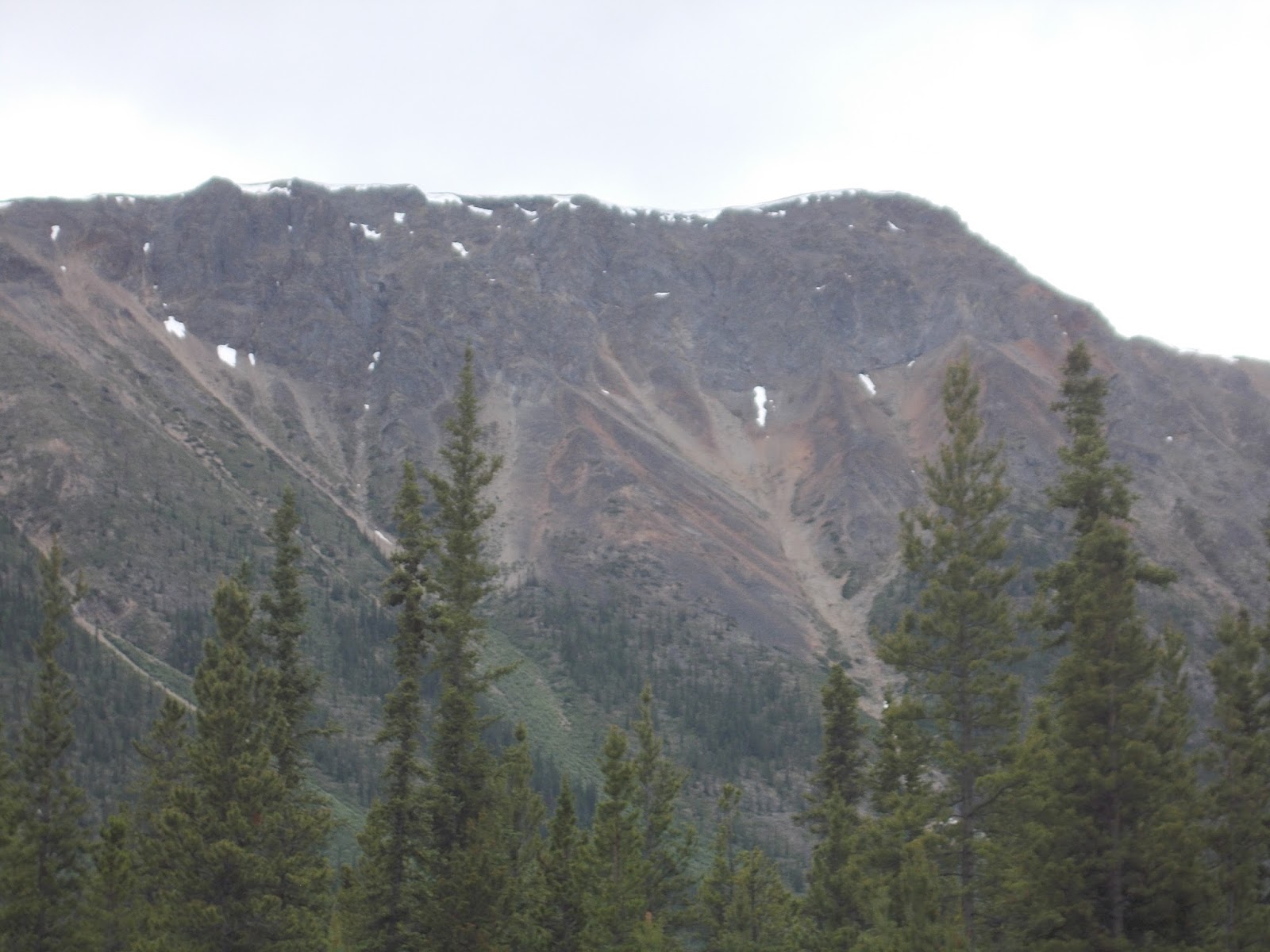
 I include this picture just to show more of the landscape.
 I was quite glad to finally get to Dawson and find Bombay Peggy's where I would spend the next two nights.
The weather was fine, a mixture of sun, clouds and the odd bit of rain. The Klondike Highway North was generally in good condition and made its way over ranges of small mountains, beside lakes and over rivers. While much of the road passed through forests, the shape of the land was such that there was plenty of vistas to keep the mind from getting bored as it does in say, Northern Ontario. Also, there were enough communities and viewpoints to stop at to allow me to find an excuse to stop and stretch my legs.


I stopped for lunch in Carmacks at the Coal Mine Campground and Canteen which Karen had recommended. They made good burgers and the owners were evidently the sort who enjoyed silly signs as there were a lot of them. This was about my favourite.

Huskies are common in the Yukon. This one seems to be enjoying his life, riding around in a sidecar.


Subscribe to:
Posts (Atom)